
Copyright protection starts with authorship, but a useful photography workflow also records permissions, publication dates and the files delivered. A gallery password cannot replace any of those records.
This guide covers U.S. copyright basics for photographers, using Copyright Office and statutory sources checked in September 2026. It is general information, not legal advice. Ask a qualified copyright attorney about disputed ownership, publication status, deadlines or a particular infringement.
Copyright ownership and your photographs
For an original photograph, U.S. protection generally begins when the work is fixed, such as when the camera records it. Publication, registration and a watermark are not prerequisites for protection. Copyright protects original expression, not an idea such as a sunset portrait or a technique another photographer may also use. See the Copyright Office’s photographer guidance.
A photograph’s creative composition can matter without giving its author exclusive rights to the subject, a pose or a lens choice. Keep the original capture and edited versions: they are useful records of your work, not a substitute for establishing ownership.
What the owner can authorize
Copyright includes rights to reproduce photographs, distribute copies, prepare derivative works and display them publicly, subject to statutory limitations. A license gives permission for specified uses. Exceptions such as fair use can permit some uses without permission; a missing credit or an unwanted repost alone does not settle every infringement question. The Copyright Office’s overview explains these rights and limits.
Delivering a JPEG does not by itself transfer copyright. Ownership of a copy and copyright are distinct under sections 202 and 204. A copyright ownership transfer generally needs a writing signed by the rights owner or authorized agent, except transfers by operation of law. Have an attorney review an assignment or exclusive license before signing it.
Studios, employees and second photographers
Do not assume that paying a photographer makes the studio the copyright owner. Work created by an employee within the scope of employment can be work made for hire. Specially commissioned work must meet specific statutory categories and an express written agreement signed by the parties; calling a contract “work for hire” is not enough by itself. Employment status is fact-specific. Circular 30 explains the distinction.
Keep each contributor’s agreement with the job records. Confirm who can license the photographs before promising a client exclusive use or sending a copyright complaint.
How long protection lasts
For works created on or after January 1, 1978, the usual individual-author term is the author’s life plus 70 years. Joint works generally run for 70 years after the last surviving author’s death. Works made for hire, and generally anonymous or pseudonymous works, use the shorter of 95 years from publication or 120 years from creation. Older works and special cases need separate analysis; use the official duration guidance.
Registration: separate ownership from court remedies
Registration does not create the underlying copyright. It does affect litigation and available remedies. For U.S. works, registration or refusal is generally required before bringing a federal infringement lawsuit; merely submitting an application ordinarily is not enough. Section 411 has exceptions, and a refusal has procedural requirements. Foreign works are not subject to that same U.S.-work prerequisite. See sections 410–412.
Registration timing also matters for statutory damages and attorney’s fees. Section 412 generally excludes those awards for infringement of an unpublished work that began before its effective registration date. For infringement beginning after first publication but before registration, its three-month exception can apply if registration occurs within three months after first publication. Special statutory exceptions exist. These rules do not promise an award or mean all other remedies disappear.
The effective date is generally when the Office receives an acceptable application, deposit and fee, if registration is ultimately granted. It is different from the date a certificate arrives. Keep all submission and decision records, and have counsel assess the actual publication, registration and infringement dates instead of calculating eligibility from the date you discovered a repost.
A registration routine for a photo business
- After culling: identify the photographs, their authors and current copyright owner. Preserve stable filenames and the originals.
- Before sharing: assess publication status and registration options. Public display alone is not publication; distribution and authorization can matter. A gallery upload date is not automatically the legal first-publication date.
- When applying: follow the current photograph registration instructions and retain the exact deposit files, title list, application and receipt.
- After the decision: archive the certificate or refusal and correspondence beside the relevant job records.
The Office offers separate published photograph group registration and unpublished photograph group registration. Each can cover up to 750 qualifying photographs, with the same author and same claimant across the group. The published option also requires publication within the same calendar year. Do not mix published and unpublished photographs in one group. Check the full eligibility, file-list and deposit instructions before applying; a folder of images is not automatically an eligible group.
Make the client’s permitted uses clear
Write down what the recipient may do before delivery. A personal-use wedding license and a vendor’s advertising license can require different terms even when they concern the same photograph. Credit, payment and access are separate questions; none should stand in for an agreed scope of use.
Use this checklist when discussing the license with your client and attorney:
- Files and recipient: identify the images and the person or business receiving permission.
- Uses and channels: distinguish personal printing, social posts, website use, paid advertising and resale.
- Extent: address exclusivity, territory and duration where relevant.
- Changes and onward sharing: state how crops, edits, vendor use and sublicensing are handled.
- Delivery and payment: explain when files will be delivered and any agreed conditions for use.
- Attribution: specify any required credit and how requests for additional uses should be made.
Illustrative planning example: a couple wants personal prints and social sharing, while their venue wants images for a paid advertisement. Record these as separate permission discussions. This is an example of issues to resolve, not a ready-to-sign license or a conclusion about an existing contract.
Prepare files and records before delivery
Keep a job record containing the source files, selected exports, contributor agreements, client license, registration material and delivery correspondence. Record filenames and export versions so that a later question can be tied to a specific photograph. Store a backup independently of the delivery gallery.
Metadata, previews and watermarks
- Authorship details: add appropriate creator, contact and rights information in your editing workflow. Keep a master record even if a later service removes metadata; see metadata management for photographers.
- Preview size: deliver the resolution needed for the review task. A smaller preview still can be copied and does not guarantee that it cannot be printed.
- Visible marks: a watermark can communicate ownership and distinguish a proof. It can also obscure important details, be cropped or be removed. Use it deliberately rather than treating it as theft prevention.
- Final delivery: provide the agreed clean files at the agreed stage. A payment or approval condition needs to be handled in the contract and workflow; a watermark does not establish it automatically.
For proofs, prioritize whether clients can judge the photograph. For vendor previews, identify the intended use before providing a clean file. For licensed finals, match the delivery to the agreement. The watermarking guide discusses practical tradeoffs.
Metadata and watermarks do not register copyright, prove that every claim is valid or prevent screenshots. Missing metadata also does not, by itself, mean that copyright is absent.
Use gallery access controls for delivery
SendPhoto’s Sharing & Downloads settings let you manage the public gallery link, optionally set a password and enable or disable downloads. Check those choices before sending the link. Share a gallery containing the files intended for that recipient, rather than assuming that a collection name creates a separate permission boundary.
A shared password is not recipient identity verification: someone can forward both the link and password. Disabling downloads does not prevent screenshots, and disabling later gallery access does not retrieve copies already saved. These settings manage delivery access; they do not change who owns copyright or what a license permits.
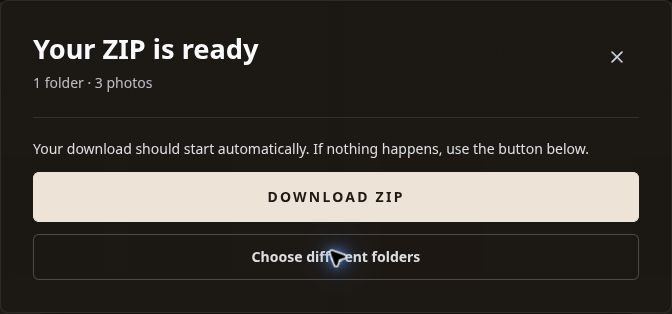
Genuine SendPhoto download dialog from the demo gallery. This shows the visitor’s file handoff, not the owner’s permission settings. Once a recipient saves a copy, later gallery access changes cannot recall that copy.
Keep license terms and delivery records in your own job archive. Do not assume a gallery is a legal audit log, a permanent backup or an automatic license-expiry system. The password-protected gallery guide covers access choices in more detail.
Respond to suspected infringement with evidence
Preserve the page before contacting its operator. Save the exact URL, account or business name, screenshots showing context and the date you observed the use. Keep the relevant original, export and agreements. Record what you know separately from assumptions, including whether a client might have authorized the use under its license.
Review ownership, permissions and possible legal exceptions before alleging infringement. The absence of credit is not a substitute for this check. For uncertain fair-use or licensing questions, take the evidence to counsel.
Platform reports and DMCA notices
The U.S. notice-and-takedown process can be available without registration. A compliant notice identifies the work and disputed material, provides contact details and a signature, and contains the required good-faith and accuracy/authority statements. Use the Copyright Office’s section 512 resources and sample notice or the platform’s designated copyright form. Only the rights owner or an authorized agent should submit it; knowingly material false claims can create liability.
A takedown is not a court finding or a guarantee of permanent removal. Under the statutory process, a valid counter-notice can lead to restoration between 10 and 14 business days after the provider receives a compliant counter-notice, unless the provider receives notice of a qualifying filed court action. Get prompt legal advice if a counter-notice arrives; do not assume a further complaint freezes that process.
When to involve an attorney
Seek help early for disputed ownership, substantial commercial use, repeated use, a counter-notice, threatened litigation or approaching deadlines. Give counsel the evidence, agreements and registration history. Discuss whether a clarification request, negotiated license, removal request or legal claim fits the facts. There is no universal escalation ladder requiring a demand letter before asking for advice.
Keep a dated record of your communications and any platform reference numbers. Avoid inventing a fee or threatening remedies you have not established are available.
International uses and AI-assisted photographs
Cross-border protection
The Berne Convention provides a framework including national treatment and automatic protection for qualifying works across member countries. It is not a worldwide enforcement service. Applicable law, exceptions and procedures depend on where protection is sought. WIPO’s Berne summary explains the framework.
For a cross-border dispute, identify the relevant people, platform and locations, then obtain advice about the appropriate jurisdiction. Do not assume a U.S. registration or a platform report resolves every country’s requirements.
Human authorship when AI tools are involved
The Copyright Office’s 2025 AI copyrightability report notice distinguishes human expressive authorship from machine-generated expression. Using AI as an assistive tool does not automatically disqualify a photograph. Protection for an output depends on sufficient human-authored expression; prompts alone are not enough.
Keep original captures, layered edits and records of which elements you created or modified. These records help describe the contribution; they do not automatically make every generated element copyrightable. Review current registration guidance when an image contains AI-generated material. An AI detector cannot establish copyright ownership or replace that assessment.
A practical next step
For the next job, bring together three things: a record of the photographs and their ownership, the agreed permitted uses, and deliberate delivery settings. Plan registration before a dispute makes the dates difficult to reconstruct.
Use SendPhoto client galleries to organize delivery and set gallery access and download choices, while keeping the license and ownership records with your own job files.