
Choose engagement photo ideas that show both the couple and the life they share. A useful session can be built around three photographs: a scene-setting image, a close portrait and a meaningful detail. Changing the distance and purpose of the frame gives you variety without visiting ten locations.
Below are three genuine visual references, followed by location and styling options, a consultation checklist and a proposed shot plan. The scene and detail photographs come from Adobe’s engagement photography guide; the close portrait is by terence b on Pexels. They are not our client work. The suggested prompts and schedule are planning examples, not a reconstruction of the pictured sessions. Exact locations and original photographer directions are not supplied by the source.
Start With the Couple and the Intended Use
Before choosing a backdrop, ask each partner what would make the session feel comfortable and useful. An engagement announcement, a vertical wedding-website portrait and a save-the-date with room for text may need different framing.
- Meaning: Which place or everyday activity feels like part of your relationship?
- Comfort: Are walking, handholding, close contact or kissing welcome? Let either person decline a prompt without explanation.
- Practical needs: How much walking, standing and travel works for both people? Is a seated alternative needed?
- Clothing: Can both people move comfortably in the outfits and shoes? Bring a warmer layer or practical shoes for transfers when appropriate.
- Output: Which images need space for text, which will be printed, and which should remain private?
- Backup: What happens if the location closes, the light changes or the weather makes the plan unsuitable?
Choose one main location and a nearby fallback. Record the meeting point, access arrangements, travel time and when the couple must arrive ready to photograph. Check the actual site’s rules before committing to a booking; a publicly accessible space is not necessarily unrestricted for an arranged photo session.
1. Make a Scene-Setting Photograph
A wider frame answers “where are we?” while keeping the couple easy to find. Look for a simple background, separation between people and scenery, and enough room around hands, feet and heads. A wide lens is an option, not a requirement: camera position, distance and framing matter too. Our environmental portrait lens guide explains the framing tradeoff.
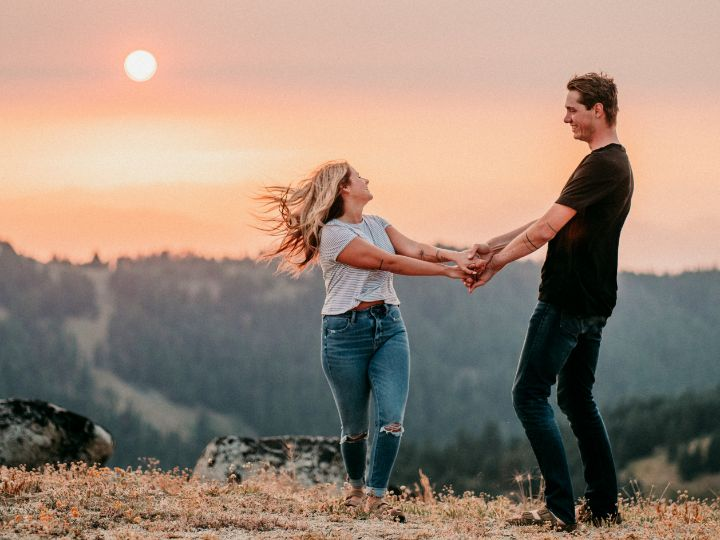
What the reference shows: the sky and distant landscape establish a place, while linked hands connect the two figures. The visible low sun gives a warm setting; the photograph alone does not establish the lighting equipment, editing or capture settings.
Try this prompt: on level, comfortable ground, ask the couple to hold hands and turn toward each other. Photograph a still version before adding a small movement they both welcome. Choose a seated or side-by-side version if leaning or standing is uncomfortable. Do not recreate a dramatic background by moving people toward an unsafe edge.
Look for in the result: both people remain readable at the intended display size, the horizon does not cut awkwardly through their faces, and the setting adds context. Capture a tighter alternative if the environment overwhelms them. Do not assume a scenic image needs less editing or will become the couple’s favorite.
2. Make a Close Portrait
Move from the setting to expressions. Agree on contact first, then offer one simple action rather than a chain of poses. A shared glance, quiet conversation or seated pause can work as well as an embrace. The couple posing guide has further direction ideas.
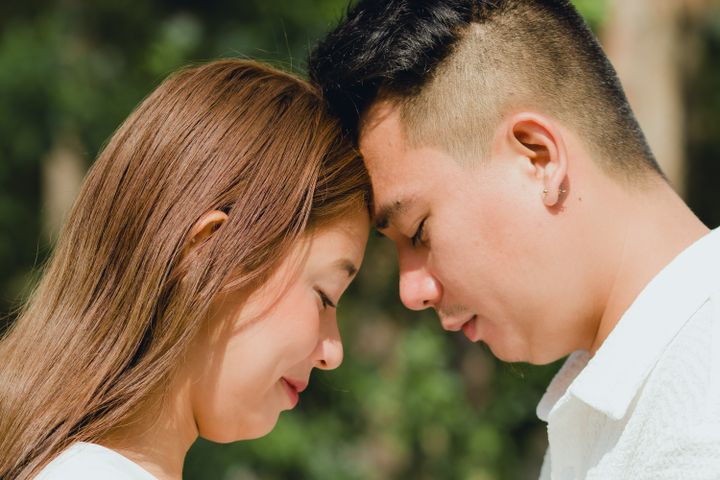
What the reference shows: both faces fill the frame and the background stays visually quiet. Treat the soft background as an observed result, not proof of a particular focal length or aperture.
Try this prompt: ask whether the couple would like to bring their faces close and look at each other. Offer a no-contact conversation instead if they prefer. Keep the camera ready between instructions, but do not label a directed pose as an unobserved candid moment.
Look for in the result: the expressions feel acceptable to both people and the important eyes are in focus. If one face is noticeably closer to the camera, a very shallow depth of field may leave the other soft. Adjust alignment, aperture or camera position and check the actual image. An 85mm lens is one choice; it is not a universal solution for focus or comfort.
3. Photograph a Meaningful Detail
A detail gives the final set a quieter beat. Hands, a ring, a familiar jacket, a shared book or another personally relevant object can connect the images to the couple. Ask whether rings and identifiable personal items should appear rather than assuming they are required.
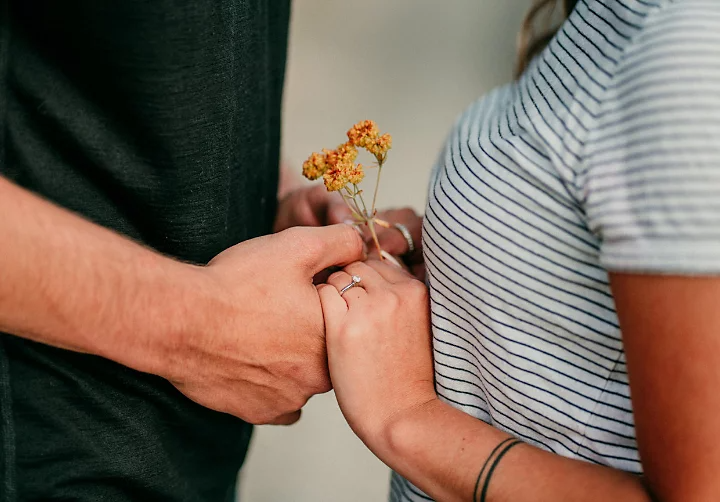
What the reference shows: hands carry the composition and the ring remains visible within the gesture. This is a close view of people together, not a standalone jewelry product photograph.
Try this prompt: have the couple rest their hands together naturally, then make a small adjustment only if a finger or sleeve hides the intended detail. Use an object they want included; do not pick plants or add props just to copy the reference.
Look for in the result: the meaningful detail is sharp enough at the delivery size, hands look relaxed and bright fabric does not draw all the attention. Try a slightly wider crop to retain the connection between the hands and bodies. A close-focusing lens may help with a tiny ring detail, but a normal portrait distance can be enough for a hands-together picture.
The scene and detail reference images are from Adobe’s engagement photography guide. The close portrait is a photograph by terence b on Pexels, used under the Pexels license. They illustrate framing choices; they are not presented as one complete contact sheet or evidence of our own session.
Choose a Setting and Style for Those Three Frames
Use the following options to adapt the scene, portrait and detail sequence. Choose the option that fits the couple’s interests, access needs, available time and budget. Location fees, permits, travel and styling can change the cost substantially; the notes below are tradeoffs rather than measured rankings.
Golden Hour: Plan Around Actual Light
An open field, beach or park edge may give you a low-sun background. Scout the direction and when buildings, hills or trees shade the chosen spot. Sunset time alone does not tell you how long useful light reaches that location, and golden-hour duration varies by place and season.
Plan and resources: allow arrival time before the chosen light, keep a nearby shaded option and bring enough battery capacity. A reflector can be useful if someone can handle it safely; it is not mandatory. Start with the wide frame while the setting matters, then move to portraits and details as the light changes. Keep skin and clothing detail under review rather than assuming warm light automatically gives flattering exposure or easy editing.
Urban Streets and Architecture: Use the Lines
Choose a familiar neighborhood, a permitted courtyard or an accessible building frontage. Windows, walls and steps can frame a couple without making the architecture the whole picture. Work from a pedestrian area and keep routes clear; a crosswalk or roadway is not a place to pause for a pose.
Plan and resources: confirm property access and any photography restrictions, avoid the busiest period, and allow time for pedestrians. A skyline view or rooftop requires a suitable authorized location. Mixed daylight and signage may need a deliberate color choice. Use one wider composition for context, then a closer frame against a quieter wall. Additional lighting, fees or assistants depend on the site and the chosen treatment.
Parks, Gardens and Nature Reserves: Stay in One Useful Area
A path, a bench and nearby planting can provide several backgrounds without a long move. This suits a couple who wants natural textures with a manageable pace. It does not guarantee a free location or an effortless session.
Plan and resources: select one main area with a usable fallback, check opening and photography rules, and match shoes and clothing to the ground. Watch for patchy light, wind, mud and insects. Use layers of foliage or distant paths for depth while staying on permitted routes. A seated portrait can add variety without adding distance.
Editorial Styling: Coordinate Without Disguising the Couple
A clean wall, graphic interior or simple studio background can support a more deliberate wardrobe and pose. “Editorial” can mean a coherent casual outfit as well as formal clothes. Keep the people’s preferences ahead of a borrowed fashion reference.
Plan and resources: agree on a small color palette and check outfit movement, fit and visible creases before photographing. A stylist, hired space or lighting kit is optional and should match the budget. Begin with a comfortable standing or seated frame; add more directed shapes only if both people enjoy them. A structured outfit and a relaxed alternative can vary the set without requiring several locations.
Seasonal Settings: Use Atmosphere and Allow Breaks
Spring flowers, autumn foliage, summer evening light or winter coats can place the images in a particular season. A blanket or a familiar drink may be enough; themed signs and elaborate props are optional tastes, not necessities.
Plan and resources: leave room for weather changes and comfort breaks, keep transfers short and choose clothing for the actual conditions. Snow, slippery surfaces, heat or poor weather can make the original plan unsuitable. Use a sheltered alternative or reschedule rather than pushing through for a seasonal image. Check the background for temporary decorations you do not want in every photograph.
An Active Outing: Photograph a Familiar Activity
A regular walk, an easy trail or a pause during a familiar hobby can give the couple something to do. Activity does not automatically create authentic expressions; choose it because they want it, not because a dramatic photograph requires it.
Plan and resources: match the route and kit to everyone’s abilities, conditions and location rules. Specialist activities such as paddling or skiing need their normal equipment and appropriate expertise; a portrait session is not the time to learn them. Stop in a suitable place for directed frames rather than asking people to watch the camera while negotiating difficult terrain. Transitions such as tying shoes, adjusting a bag or taking a break can supply the detail image. Carry less camera gear only when doing so does not remove necessary safety or weather equipment.
A Destination: Simplify the Schedule
A meaningful travel location can supply distinctive architecture or scenery. It also introduces transport, accommodation, equipment and access costs. A local setting may tell the couple’s story just as well.
Plan and resources: check site information before arrival, allow recovery time after travel and confirm a short route. Covered walkways or a booked interior can provide weather options when photography is allowed. Start with a place-setting frame, then make portraits and details so the gallery is not only a series of distant landmark pictures. Avoid building a plan around several locations that depend on perfect traffic or weather.
Everyday Life: Let a Real Routine Set the Pace
A breakfast at home, a favorite bookshop with permission, a neighborhood walk or a shared record collection can support a personal sequence. Familiar surroundings may help, but ask the couple rather than promising they will relax there.
Plan and resources: ask what they enjoy on an ordinary good day and choose one activity with space for the camera. Agree with a venue owner before using their business as a set, and avoid involving bystanders without their agreement. At home, remove private documents and items the couple does not want shown. Photograph the room, the interaction and one detail. If the activity feels staged or uncomfortable, change the prompt rather than forcing a performance.
A Proposed 45-Minute Shot Plan
This is a fictional planning example for a couple who wants a short garden session, dislikes elaborate posing and needs one horizontal announcement image. It is not a tested schedule or a promise about how many finished photographs a session will produce. Allow access and travel time separately, and adapt the pace to both people.
- Minutes 0–5: settle in. Confirm comfort, contact preferences, clothing and the fallback location. Make a simple standing or seated frame to check light and focus.
- Minutes 5–15: show the place. Photograph a wide scene with both people, then a closer version. Include one horizontal composition with clean space for the announcement text.
- Minutes 15–25: concentrate on faces. Try a shared glance or conversation, plus a quiet portrait. Check both faces before changing position.
- Minutes 25–32: make details. Photograph hands, the agreed ring view or one meaningful object. Keep the clothing and background connected to the earlier frames.
- Minutes 32–40: add a different rhythm. Use a short walk on a suitable path or a seated alternative. Photograph the transition as well as the pause.
- Minutes 40–45: check the brief. Confirm that the requested orientation and essential portraits are covered. Use remaining time for the couple’s preference, not an automatic extra pose.
Review the planned set as scene, portrait, detail, movement or transition, and a quiet closing frame. That is a proposed sequence, not a contact sheet from the reference photos. It gives the gallery composition variety while keeping the session in one place. If time runs short, prioritize the couple’s must-have use rather than completing every prompt.
Deliver the Finished Set Clearly
Curate a sequence that moves from context to faces and details. Remove near-duplicates that add no useful variation, and retain enough alternatives for the agreed uses. If you supply both print and web versions, label them plainly and explain which to use. Check the destination’s current crop and upload requirements before making a social-media export.
Use stable filenames when asking the couple to identify choices. For example, ask them to reply with the filenames for their announcement and print selections. Do not assume a gallery platform has favorites, approval tracking or automatic expiry. Our photo-sharing guide covers the wider handoff choices.
With SendPhoto, gallery delivery provides a place to present the finished set. Configure the available download controls and, when appropriate, a gallery password. A password gates entry but does not establish the viewer’s identity; recipients can forward it. Download settings do not prevent screenshots or later sharing of saved copies.
Agree separately whether the couple permits public portfolio or social use. Keep your own backup and editable masters, tell the couple how long you intend to keep their gallery available, and explain how to save their delivered files. Clear curation, access instructions and file labels help the couple find and use the right images.