
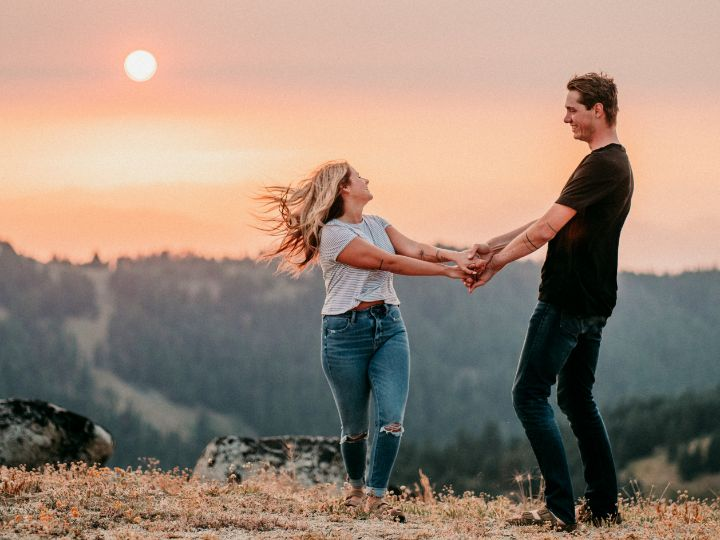
Start couple posing with one comfortable action: look at each other, hold hands if welcome, or move together along a clear path. Check hands and face visibility, then vary the expression or framing before changing the whole setup.
Ask both people which contact and movements feel comfortable before directing them. Offer an option without touching, walking or sitting on the ground. Explain a change verbally or demonstrate it on yourself; ask permission before physically adjusting anyone.
This guide is about directing a session rather than choosing locations or themes. The credited photographs below are existing published examples; the suggested prompts and practice sequence are not a report of our own shoot.
Start With Connection Points
A couple pose needs a visible relationship between the people in the frame. That connection can be physical, visual, or emotional.
Common connection points:
- Hands touching.
- Arms around waist, shoulder, or back.
- Foreheads close together.
- One person looking at the other.
- Bodies angled slightly inward.
- Walking in the same direction.
- Sitting close enough that the pose feels intentional.
Do not require constant contact or assume closeness means kissing. Ask “Would you prefer holding hands or looking toward each other?” Let either person decline. A shared gaze or direction can show connection while leaving space between bodies.
Use Prompts Instead of Rigid Instructions
Rigid instructions can make people freeze. Prompts give couples a task, which creates expression and movement.
| Goal | Prompt |
|---|---|
| Natural smiles | If walking is comfortable, move together slowly and look at each other; shoulder contact is optional |
| Quiet connection | Hold hands if welcome, or leave space and look toward each other |
| Movement | Walk along this clear path, stop, then turn toward each other; a gentle seated turn is an alternative |
| Laughter | Share a light memory or inside joke if you want; a quiet expression works too |
| Calm portrait | Pause at a comfortable face distance; bring foreheads closer only if both want to |
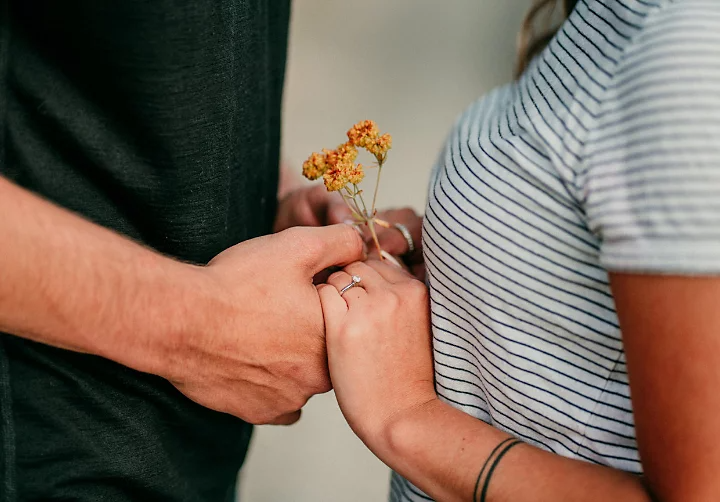
| Detail shot | Hold hands and let your fingers relax |
Give one prompt, wait for the response, then make one correction. For example: “Turn toward each other.” After they settle: “Let the hand on the arm rest lightly.” If expressions tighten, stop adding instructions and offer a pause.
In Adobe’s engagement-posing guide, photographer Dezerae Jobe describes asking people about their relationship and having them answer each other. That is a documented photographer example, not a guarantee of laughter; use a topic both people are happy to discuss.
For broader concept ideas, use creative couple photoshoot ideas.
Direct Hands Clearly
Hands can make a pose look polished or awkward. Couples often do not know what to do with them, so direct hands early.
Useful hand directions:
- Hold hands loosely instead of gripping tightly.
- Place one hand at the waist, upper back, or arm.
- Let fingers relax.
- Avoid flat palms pressed hard against the body.
- Keep hands visible when they add connection.
- Hide or soften hands only when they distract.
For close portraits, check whether a hand pulls clothing, grips tightly or presses uncomfortably. Try “Let your fingers rest” instead of asking for an unnatural bend. Keep enough of the wrist or arm visible to show whose hand it is; change your angle if fingers merge confusingly.
Watch Face Angles
Face angle affects connection and comfort. If both people face the camera straight on, the pose can feel formal. If both look away, the photo may lose emotional focus.
Try variations:
- One person looks at camera, one looks at partner.
- Both look at each other.
- One person looks down while the other leans in.
- Both look in the same direction for a quieter editorial feel.
- Foreheads close, eyes closed, relaxed expression.
Check that both faces remain visible from your position. A forehead or nose-to-nose prompt is optional; do not push faces together. Move yourself a small amount or ask for a comfortable turn if one face blocks the other. Take an eyes-open alternative when an eyes-closed version would hide an expression you want.
Pose for Height Differences
Height differences are not a problem. They just need thoughtful positioning.
Try:
- Put the taller person slightly behind or seated.
- Use a stable step or gentle level change only when both people can use it comfortably; skip unstable rocks or exposed edges.
- If using a safe gentle slope, try the shorter person uphill; level ground is an equally valid choice.
- Use walking prompts so height feels less posed.
- Try a closer composition when faces and expression matter more than full-body posture; do not crop merely to hide a person’s height.
- Seat both people to bring faces closer.
Keep directions independent of gender and avoid describing one person’s body as a problem. Equal face height is not a requirement. If one person sits behind the other, check that the position does not hide their face; if neither wants to sit or lean, change your camera position instead.
Build a Walking Sequence
Walking gives willing subjects a simple shared task. Choose a clear, level route and keep everyone away from traffic, water edges and obstacles. For people who prefer to remain still, use the same gaze and hand variations while standing or seated.
Simple walking sequence:
- Offer hand holding or side-by-side movement and agree where to stop.
- Walk slowly toward the camera, looking ahead first; add a brief glance toward each other only when footing is clear.
- Let expressions happen without demanding laughter. Make a few frames, then pause.
- Stop fully before turning slightly inward.
- If welcome, reduce the space between them for a quiet portrait; keep a no-touch version too.
- For an away-facing variation, stop before asking for a glance back rather than turning while walking.
A proposed four-frame practice sequence is a wide side-by-side view, a stopped inward turn, a closer portrait with both faces visible, and a hand detail if touch is welcome. Keep the setting constant so you can compare the changes. This is a plan to try, not an actual contact sheet or a promise of four successful frames.
Use Seated Poses for Calm Moments
Offer a stable bench or supportive chairs when a seated setup suits the couple. A blanket or floor pose is optional, not a requirement. Ask about comfortable positions without requesting medical details; preserve space for mobility aids and do not move an aid without permission.
Seated posing tips:
- Keep bodies angled toward each other.
- Stagger knees and feet so legs do not look stiff.
- Place hands with intention.
- Ask one person to lean lightly into the other.
- Shoot wide for environment, then move closer for hands and faces.
- Watch posture so the pose feels relaxed, not collapsed.
A seated setup reduces the movement you need to direct, but it is not automatically more comfortable for everyone. Keep it brief if requested, allow a standing alternative and check that both people can enter and leave the position comfortably.
Capture Detail Shots
Detail shots help tell the story and give couples variety in the final gallery.
Look for:
- Hands.
- Rings.
- Fabric and flowers.
- Shoes while walking.
- Shoulder or back embrace.
- Hair movement.
- Close crop of faces.
- Shared objects, pets, or meaningful locations.
A detail frame can also offer a break from looking at the camera. Ask before including a private tattoo, meaningful object or identifiable location. Keep details that belong to this couple’s story rather than assuming every session has rings or flowers.
Reset Awkward Moments
If a prompt feels forced, pause rather than adding pressure. A quiet portrait is a valid result; the couple does not owe the camera laughter, affection or an explanation for declining a pose.
Try:
- Lower the camera and talk for a few seconds.
- Give a simple walking prompt.
- Ask them to shake out their shoulders.
- Move to a new background.
- Switch from camera-facing to looking at each other.
- Photograph details before returning to full portraits.
Use a neutral direction such as “Let’s try a simpler version,” or offer a rest. If someone declines contact or movement, change the setup without negotiating their boundary. Moving to another background should serve the picture, not add pressure to keep going.
A Proposed 20-Minute Posing Set
This four-part plan totals 20 minutes of posing time. It excludes consultation, travel and setup, and can be shortened or paused. It is not a measured session or an output guarantee.
| Time | Focus | Shot types |
|---|---|---|
| 0 to 5 min | Warm up | Agreed movement or stationary alternative; simple shared gaze or optional hand holding |
| 5 to 10 min | Connection | Close portraits, looking at each other; forehead prompt only if welcome |
| 10 to 15 min | Variety | Comfortable seated or standing alternative, environmental frames and details |
| 15 to 20 min | Favorites | Repeat strongest setup with refined expression and light |
Repeat the setup the couple liked most rather than forcing every category into the schedule. The last five minutes are for refining a chosen picture: clear hands, readable faces, comfortable posture and a clean background. If the session runs short, omit a variation instead of rushing consent or footing.
Camera and Composition Notes
Posing works better when the camera choices support it.
- Choose your camera distance first, then a focal length that frames the couple from there. A longer lens often lets you work farther away; there is no universally flattering length.
- Keep background distractions away from faces.
- Watch hands, elbows, and feet at the frame edge.
- Shoot both vertical and horizontal versions.
- Step closer after each wide setup for detail frames.
- Keep light soft and directional when possible.
Camera distance changes perspective. Nikon’s perspective guide illustrates changing distance while keeping a subject the same size with different focal lengths; it is not a claim that zooming alone changes viewpoint.
Check both important faces for focus, particularly when one is farther from the camera. Stop down when you need more depth of field, then recheck shutter speed and exposure. Nikon’s portrait reference cautions that a very wide aperture can leave too little in focus. There is no single aperture or shutter speed that fits both still portraits and moving couples.
For camera fundamentals, see camera settings for beginners. For portrait lighting and composition, see portrait photography masterclass.
Delivering Couple Galleries
Couple sessions often include private, emotional, or family-sensitive images. A clean delivery workflow helps the finished set feel professional.
Curate a set with a scene-setting portrait, a few expressions and meaningful details rather than sending every near-duplicate. Ask which photos may be shared publicly; permission to deliver a private gallery does not establish permission to post it to your portfolio.
SendPhoto offers client gallery delivery and gallery password access. Configure the intended sharing audience and downloads separately. Anyone who receives a shared link and its password may forward them; changing access cannot retract files already downloaded. Keep your originals and backups independently of the gallery.
Couple Posing Checklist
- Start with a simple connection point.
- Give one prompt at a time.
- Direct hands early.
- Offer an inward angle or shared gaze without forcing touch.
- Vary eye direction.
- Offer comfortable movement or a stationary variation when a prompt feels forced.
- Offer a stable seated setup or standing alternative for a quieter portrait.
- Capture hands and other detail shots.
- Reset awkward moments without naming them.
- Deliver the final set in a way that feels private and easy to browse.
FAQ
What is the easiest couple pose for beginners?
Hand holding and a slow walk can be a useful start when both people welcome them. For a stationary or no-touch option, ask them to face slightly toward each other and share a gaze. Choose the simplest action they find comfortable.
How do you make couple poses look less awkward?
Give one direction at a time, check hands and face visibility, and pause if expressions tighten. Offer a simpler or no-touch version rather than insisting on movement or laughter.
What should couples do with their hands?
Hands should connect naturally: holding hands, resting on an arm, waist, back, or shoulder, with fingers relaxed.
How do you pose couples with a height difference?
Try level-ground standing, stable seats or a slight front-to-back offset while keeping both faces visible. Safe gentle level changes are optional. You do not need to make their heights match.
Should every couple pose include touching?
No. Touch helps show connection, but eye contact, movement, shared direction, and body angle can also create connection.