
PicDrop's current structure starts with Free at 1 GB and 3 galleries, followed by annual paid tiers at €8.39 per month for 500 GB, €12.59 for 1 TB, and €75.59 for 3 TB. The right choice depends on more than the subscription fee, because storage, gallery volume, team access, video processing, and add-ons determine the delivery cost.
A photographer choosing a gallery platform today may be comparing a small portrait job with a packed calendar of weddings, events, or commercial shoots. The headline plan price can look manageable until storage headroom, processing limits, and billing-cycle commitments enter the decision. This guide examines PicDrop pricing as a delivery-economics question, then compares the available evidence with SendPhoto's official pricing and product information checked in September 2026.
Table of Contents
- Introduction to PicDrop Pricing for Photographers
- How PicDrop Pricing Is Structured Today
- PicDrop Pricing vs SendPhoto at a Glance
- Storage Add Ons Video Limits and Hidden Cost Drivers
- Which Plan Fits Your Photography Workflow
- Switching and Saving Without Surprises
- Final Recommendation and Value Verdict
Introduction to PicDrop Pricing for Photographers
A quiet portrait month may fit within a small gallery plan. A busy month of weddings, events, or commercial shoots can expose a different cost structure, because delivery depends on storage headroom, gallery capacity, and video processing quotas. The subscription fee is only the starting point for estimating delivery cost.
The practical constraints are distinct:
- Storage headroom: Active and archived client work can consume the allowance, creating pressure for upgrades or paid capacity extensions.
- Gallery capacity: Unlimited galleries on paid tiers can reduce the need to remove completed projects from client access.
- Video processing: Video delivery may draw on a monthly processing quota, so available storage alone does not establish how much work a plan can handle.
PicDrop's annual monthly-equivalent prices are €8.39, €12.59, and €75.59 for its paid tiers, while the free option provides 1 GB of storage and 3 galleries. These figures should be evaluated against a studio's normal project volume, retention habits, and video requirements, rather than compared as subscription prices alone.
SendPhoto's publisher information describes a free tier with 5 GB and one active gallery, paid storage scaling from 20 GB to 500 GB, unlimited galleries on paid plans, and pricing beginning at $3 per month. Photographers should verify the current tier details on SendPhoto's official pricing page before purchase.
This guide uses published prices and stated allowances, not private invoices, customer case studies, or hands-on tests. Scenario calculations therefore show capacity trade-offs, not guaranteed margins for a particular month.
Practical rule: Choose the plan that covers normal storage and delivery needs without frequent upgrades or capacity extensions.
How PicDrop Pricing Is Structured Today
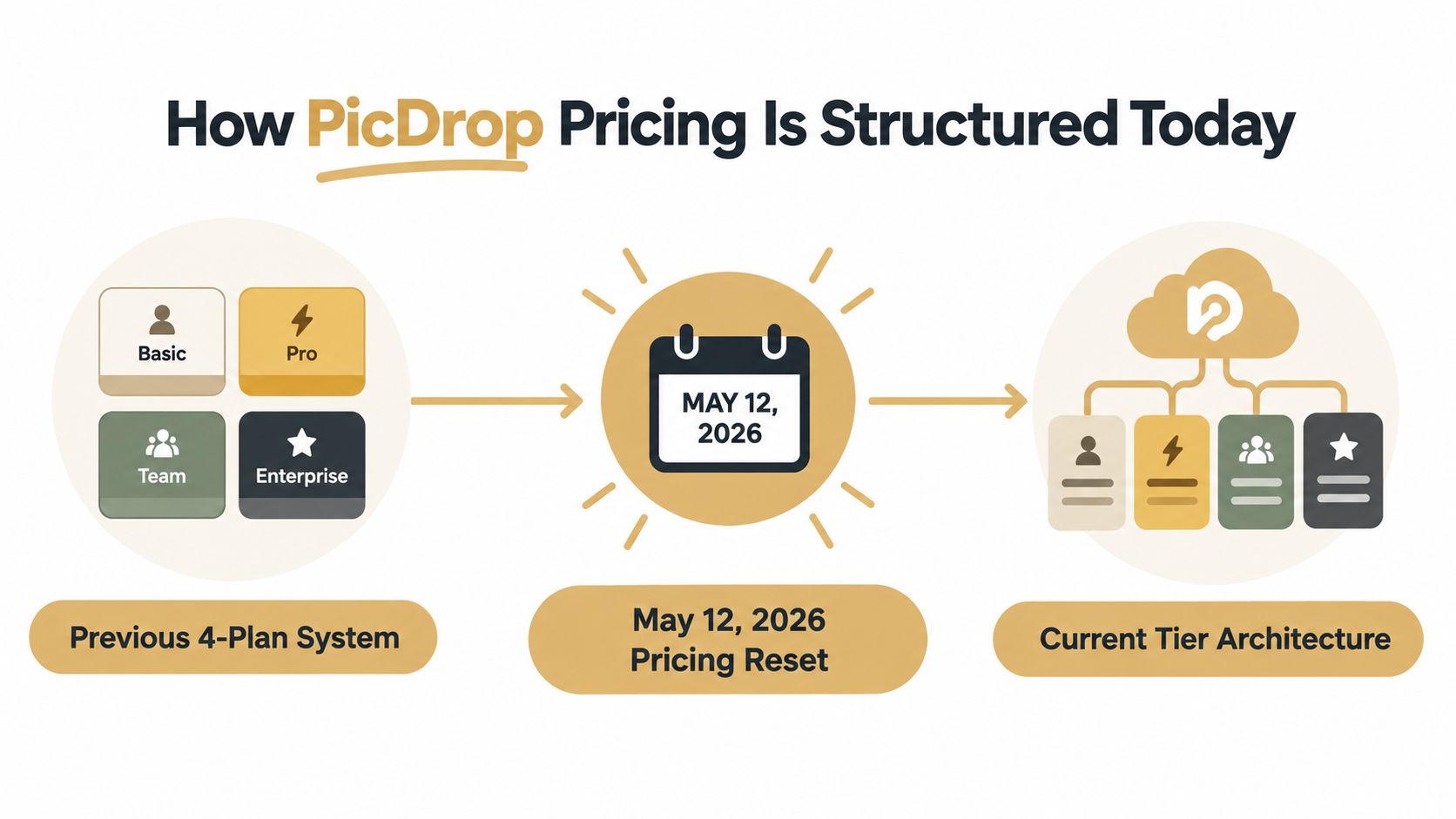
PicDrop's current offer represents a formal pricing reset, not a minor adjustment. The company says its previous lineup included Free, Lite, Pro, and Business, while new plans and prices applied to new customers from May 12, 2026. Existing customers were to receive notice by email and in their accounts before any change affected their charges, according to PicDrop's pricing update.
The current capacity ladder
The present structure increases operational capacity at each paid level:
- Free: 1 GB of storage and 3 galleries.
- Pro: 500 GB, unlimited galleries, and one hour of video processing per calendar month.
- Advanced: 1 TB, up to 4 team members, and two hours of video processing per calendar month.
- Business: 3 TB, up to 9 team members, and four hours of video processing per calendar month.
Annual billing costs €8.39 per month for Pro, €12.59 for Advanced, and €75.59 for Business. The free tier has narrower storage and gallery allowances. For a studio with a busy gallery month, the relevant cost is therefore the combination of storage headroom, video-processing time, and any paid capacity extensions, rather than the subscription figure alone.
PicDrop also publishes monthly net prices of €14.99 for Pro, €39.99 for Advanced, and €99.99 for Business in its German pricing information. Annual billing lowers the monthly equivalent, while monthly billing may suit photographers whose demand changes across the year. The better choice depends on whether predictable usage justifies committing to the longer billing cycle.
Trials and customer migration
Advanced includes a 14-day free trial, according to the company's trial and contract FAQ. That option allows photographers to test whether the included storage, gallery volume, team access, and video quota match an actual workflow before committing.
Existing subscribers should treat the May reset as a migration event. Their individual account notice matters more than assuming that a public new-customer price applies immediately.
Practical rule: The economical plan is the one that matches the studio's normal storage and delivery pattern without forcing frequent upgrades or paid capacity extensions.
Photographers comparing alternatives can browse pricing options for wider market context. Any comparison should keep entry price separate from equivalent capacity, because storage, galleries, team access, and video processing can change the total cost of delivery.
PicDrop Pricing vs SendPhoto at a Glance
A busy gallery month can make the cheapest sticker price misleading. The relevant comparison is recurring subscription cost plus the storage, delivery controls, and video-processing capacity required for actual client work. PicDrop publishes euro prices and defined plan limits, while SendPhoto's published information uses dollar-denominated entry pricing and storage tiers. The available verified data does not establish a complete SendPhoto tier-by-tier schedule, so the table avoids estimates.
The PicDrop figures below were checked against official sources in September 2026. SendPhoto's stated product details and starting price were also checked in September 2026. Before subscribing, confirm the live checkout price, billing cycle, taxes, and included features.
PicDrop vs SendPhoto Pricing and Feature Comparison
| Plan Tier | Monthly Price Annual Billing | Storage and Galleries | Key Delivery Features |
|---|---|---|---|
| PicDrop Free | Not stated in the verified pricing data | 1 GB, 3 galleries | Free-tier access is limited compared with paid plans |
| PicDrop Pro | €8.39/month | 500 GB, unlimited galleries | Image and video formats, paid features, video streaming and previews, 1 hour of processing per calendar month |
| PicDrop Advanced | €12.59/month | 1 TB, up to 4 team members | Expanded paid workflow, video processing, 2 hours per calendar month |
| PicDrop Business | €75.59/month | 3 TB, up to 9 team members | Expanded team capacity, video processing, 4 hours per calendar month |
| SendPhoto free tier | Starting structure verified, exact annual figure not stated | 5 GB, one active gallery | Client-gallery delivery with the free allowance described by the publisher |
| SendPhoto paid tiers | Starting at $3/month, exact tier schedule requires live verification | Paid storage scales from 20 GB to 500 GB, unlimited galleries on paid plans | Password protection, custom watermarks, expiring links, download controls, RAW and HD video support, branding options |
PicDrop Pro suits a solo photographer whose normal workload fits within 500 GB, unlimited galleries, and 1 hour of processing per calendar month. The official photo-sharing page lists those limits, along with all image and video file formats and available features. Monthly billing is shown as $15.99 or €14.99 per month plus VAT, as described in PicDrop's photographer photo-sharing information.
SendPhoto addresses delivery controls through password protection, expiring links, watermarks, download settings, custom domains, and RAW or HD video support. Those features may reduce the need for separate tools, although plan-level access requires confirmation from the provider's current pages. Photographers weighing branding and client access can review the PicDrop and SendPhoto comparison before choosing on price alone.
For a wider software shortlist, check pricing plans, then compare equivalent storage and delivery capacity. A lower entry price does not necessarily mean a lower delivery cost if a busy month requires added storage or more video processing.
Storage Add Ons Video Limits and Hidden Cost Drivers
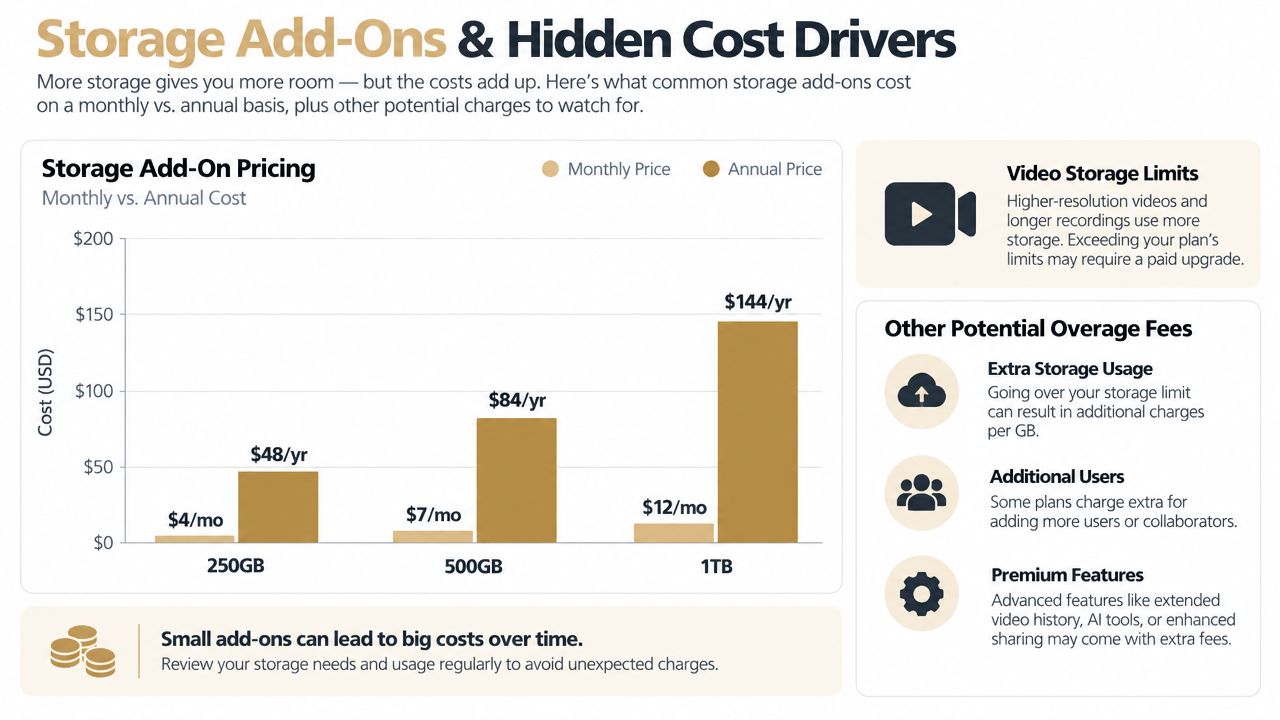
A busy gallery month can raise delivery costs through two separate channels: stored files and processed video. PicDrop's subscription price therefore does not show the full capacity calculation. Pro customers can add 250 GB for €7.99 net per month, Advanced customers 500 GB for €19.99 net per month, and Business customers 1 TB for €49.99 net per month, according to PicDrop's German pricing information.
Add-ons versus moving up a tier
The relevant decision is the break-even point between extra capacity and a higher plan. A Pro customer exceeding the included 500 GB can purchase storage, but repeated add-ons may make Advanced more economical because it includes 1 TB. For a studio, Business adds 3 TB and team access, so its higher fixed price makes sense only when those capabilities replace separate capacity or administration needs.
Annual billing changes the displayed monthly cost. The listed annual prices reduce that figure by about 44% for Pro, 68% for Advanced, and 24% for Business, based on the official German pricing figures. The saving matters only if the photographer expects to retain the plan through the billing period. Month-to-month billing may cost more but preserves flexibility.
Video creates a second ceiling. PicDrop includes streaming, preview images, and quick previews from Pro upward. Its monthly processing quotas are 1 hour for Pro, 2 hours for Advanced, 4 hours for Business, and 6 hours for Enterprise. A video-heavy studio can therefore reach its processing allowance before filling its storage, especially during a month with several large client galleries.
SendPhoto's publisher information describes included storage, RAW and HD video support, and paid tiers scaling to 500 GB, but the supplied evidence does not verify equivalent video-processing hours or paid storage overage terms. Compare those allowances before treating the services as interchangeable. File-size rules also affect delivery planning, so studios handling large exports should review SendPhoto's file-size guidance.
Which Plan Fits Your Photography Workflow
The right tier depends on the month's delivery workload. A wedding studio, portrait photographer, commercial team, and solo filmmaker may all use client galleries, yet storage, collaboration, and video processing can create very different costs. Compare the full delivery requirement, including add-ons and processing limits, rather than the advertised monthly tier alone.
Wedding and event photographers
A studio delivering 50 or more galleries needs more than the free allowance of three galleries. PicDrop Pro is the first verified PicDrop tier with unlimited galleries and 500 GB of storage. Advanced adds 1 TB and team access. Pro is the lower-cost starting point when video processing remains within its quota and the studio works independently. Advanced becomes easier to justify when heavier video, shared administration, or repeated storage add-ons would otherwise raise monthly delivery costs.
SendPhoto's paid plans also include unlimited galleries according to the publisher information, while its free tier permits one active gallery. Gallery count therefore does not decide the comparison by itself. Confirm the exact paid-tier price on SendPhoto's pricing page before committing, then compare included storage and processing terms.
Portrait and family photographers
A portrait photographer with seasonal demand may use the free tier while testing the service, but 1 GB and 3 galleries provide limited room for continuing client delivery. A paid tier becomes more practical when galleries must stay available between sessions or when the photographer needs storage headroom without repeatedly managing files.
SendPhoto's free allowance provides 5 GB and one active gallery, which may suit short-term delivery with fewer simultaneous projects. The trade-off is broader active-gallery capacity on one side and greater free storage on the other.

Commercial studios and small teams
For a commercial studio, team access can affect total cost more than storage alone. PicDrop Advanced supports up to 4 team members, while Business supports up to 9. The higher tier makes financial sense when those seats reduce separate administrative work, or when its storage and video allowance prevent recurring add-on purchases.
Decision rule: Choose Business only when its storage, team allowance, or video capacity replaces a measurable operational cost. A larger plan name alone does not justify the higher fixed price.
Solo photographers sharing RAW and HD video
A solo photographer delivering RAW files and HD video should evaluate format support, storage, and monthly processing together. PicDrop Pro supports all image and video file formats according to the official photo-sharing page, but its processing allowance is limited to 1 hour per calendar month. A busy month with several large galleries can therefore hit the video ceiling before storage is full.
SendPhoto's publisher information describes RAW and HD video support, but exact plan limits require current official confirmation at checkout. The economical choice depends on the binding constraint: gallery volume, archive size, video processing, or branded client access.
Switching and Saving Without Surprises
A reliable switch begins with usage records, not the most attractive advertised tier. Track current storage, active galleries, required team access, and video processing during busy periods. This separates a real capacity shortfall from a preference for another interface or presentation style.
Choose the billing cycle deliberately
Annual billing reduces PicDrop's displayed monthly equivalent for paid tiers, but requires a longer commitment. Monthly billing may suit seasonal photographers who need expanded capacity only during selected periods. Annual billing is easier to justify when client delivery remains a permanent studio function.
Recheck the published figures before payment. PicDrop separates monthly and annual rates, and its 2026 reset applies differently to new and existing customers.
Audit add-ons before upgrading
An add-on can address a temporary storage spike. Repeated extensions indicate that the base tier may no longer fit the archive. Compare accumulated add-on spending with the next plan's included storage, team seats, and video allowance. This shows whether upgrading lowers delivery costs or merely increases fixed spending.
Before changing plans: Export or otherwise preserve required client files, document gallery names and access settings, and confirm how the current provider handles existing galleries during a downgrade or migration.
Move galleries in a controlled sequence
Use a small test before committing the entire archive:
- Start with one completed project: Check uploads, downloads, passwords, presentation, and client access before moving all galleries.
- Keep a project register: Record each gallery's status, delivery deadline, expiration, and access requirements.
- Move active work first: Client-facing galleries take priority over older archives that no longer require immediate access.
- Verify the replacement: Test the new link and download behavior before retiring the original gallery.
- Review the first billing period: Confirm that selected storage and gallery allowances match the studio's actual operating pattern.
SendPhoto describes bulk uploads, RAW and HD video support, password protection, watermarks, expiring links, download controls, and paid tiers scaling from 20 GB to 500 GB. Photographers considering that route should verify current terms on SendPhoto's official site rather than relying on assumptions from another service. The financial comparison should include the cost of temporary overlap, any required migration work, and video processing needs during the busiest gallery month.
Final Recommendation and Value Verdict
PicDrop makes the strongest financial case for photographers who can keep paid storage and gallery capacity in regular use. Pro suits solo workflows needing unlimited galleries and 500 GB. Advanced becomes more suitable when 1 TB, team access, or additional video processing is part of delivery. Business targets larger archives and wider collaboration.
The monthly plan price is only one part of the calculation. A busy month may require extra storage, while video galleries can consume processing capacity. If a studio temporarily holds a large archive and delivers several video-heavy projects, the relevant cost is the plan plus any add-ons and migration overlap, not the advertised tier alone.
SendPhoto remains relevant when branded delivery controls, RAW and HD video support, and a simpler storage ladder matter more than PicDrop's larger upper-tier capacity. Its published information describes a free allowance, paid storage up to 500 GB, unlimited galleries on paid plans, and a starting price of $3 per month. Verify the current tier mapping before purchase.
| Workflow priority | More logical starting point |
|---|---|
| Testing gallery delivery with very limited active work | PicDrop Free or SendPhoto's free tier |
| Unlimited galleries with substantial solo storage | PicDrop Pro |
| Larger archive and a small team | PicDrop Advanced |
| Large archive and a broader team | PicDrop Business |
| Branded handoff with listed RAW and HD video support | SendPhoto, subject to current plan verification |
The practical verdict is to compare total capacity and delivery controls, not the sticker price alone. Choose PicDrop when its storage, gallery, team, and video allowances match the busiest delivery cycle. Choose SendPhoto when its stated branding, security, and file-delivery model better fits client handoffs. Review storage add-ons and video processing before committing.