
A boudoir photography client gallery should be a private, password-protected link with watermarked previews, downloads disabled during selection, and an automatic expiry. The client should approve access and image use before any file is uploaded, then receive final downloads only after the selection is confirmed.
A client may be reviewing intimate photographs on a shared tablet, a partner's laptop, or a phone that automatically backs up images. A careless gallery setup can expose more than the photographer intended, even when the original session was handled with discretion. The delivery system must therefore protect the client's choices before it delivers the studio's files.
Table of Contents
- Why Boudoir Galleries Need Privacy-First Delivery
- Setting Up the Gallery Before the Shoot
- Choosing a Two-Stage Delivery Model
- Building the Client Selection Experience
- Retouching, Watermarks, and Visual Controls
- Closing the Gallery After Delivery
- Final Privacy Checklist and Follow-Up
Why Boudoir Galleries Need Privacy-First Delivery
Boudoir photography has a history that makes privacy especially important. As a recognizable style, it has roots in France around 1890, and the first postcard featuring a naked woman circulated there in 1900. The genre later moved away from taboo or illegal framing toward client-centered portraiture in the late twentieth and early twenty-first centuries, as documented in the history of boudoir photography. Modern delivery should reflect that shift. A private gallery is not merely a convenient file-transfer page. It's part of the client's control over her own images.
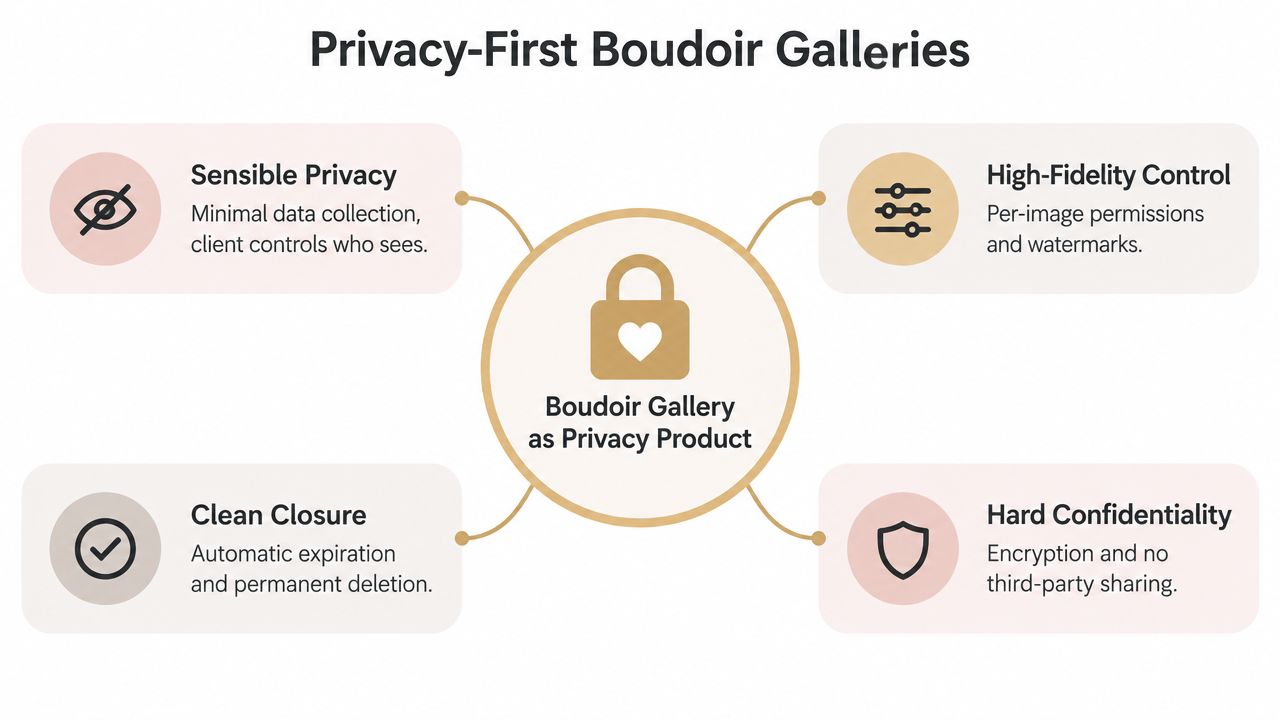
Four principles should govern every setting:
- Consent: The client decides whether images may be used for portfolio, advertising, social media, or partner viewing.
- Control: The client decides who receives access, which images become finals, and when downloads begin.
- Confidentiality: The gallery limits accidental exposure through passwords, discreet communication, watermarks, and controlled sharing.
- Closure: The photographer sets an end date, revokes access, and retains files only under the agreed terms.
The risks are practical. A preview can appear in a shared household browser history. A partner can screenshot a favorite and forward it without permission. A model release can be interpreted too broadly if the contract doesn't distinguish private delivery from public promotion. A cloud folder can remain available indefinitely after a relationship changes or the client withdraws permission for future use.
Each risk demands a matching control. Separate the password from the gallery link so a forwarded email doesn't automatically grant access. Disable downloads during proofing so unretouched files aren't casually saved or redistributed. Use watermarked previews to discourage screenshots from becoming unofficial finals. Set an expiry window and revoke access rather than leaving an intimate archive open forever. The photo-sharing security guidance from SendPhoto offers a useful reference point for building those controls into a broader delivery policy.
The same privacy-first mindset can shape the rest of the client journey. Studios that also manage inquiries, appointments, and client communication may find a Recepta.ai beauty industry assistant relevant for organizing front-of-house communication, while the gallery itself remains the controlled handoff for images.
Setting Up the Gallery Before the Shoot
The safest boudoir photography client gallery is configured before the camera comes out. Pre-shoot preparation prevents a rushed upload from becoming the first moment when the photographer considers consent, access, or retention.
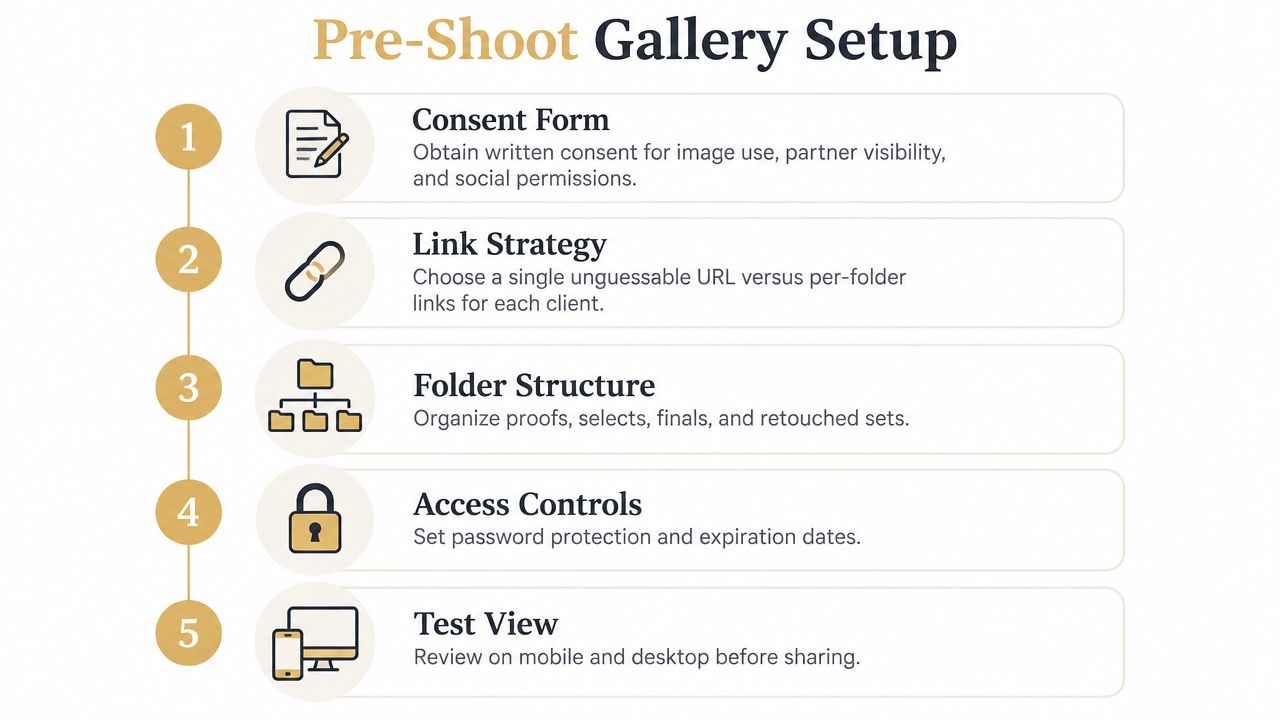
1. Record the client's consent
The written agreement should separate private delivery from every form of public use. It should state whether the photographer may show images in a portfolio, submit them for publication, share them with vendors, display them in studio samples, or post them on social platforms. Partner visibility also needs an explicit choice. A client may authorize delivery to a partner while refusing public release, or approve one image for marketing while keeping the rest private.
Consent should identify the person who can make gallery decisions. If a couple is involved, the client photographed should remain the decision-maker unless written authorization says otherwise. Archive the signed record before uploading any proof.
2. Use one unguessable gallery link
A single private link keeps the client's proofing path coherent. It should not use the client's full name, session date, or a predictable folder label. A per-folder structure can separate proofs, selects, and finals inside that private environment, but separate public-facing URLs create more opportunities for forwarding and confusion.
Password protection must sit in front of the gallery, not in the contract alone. Independent guidance on secure WordPress pages for clients also illustrates the broader principle that sensitive client content needs an access barrier rather than an obscure URL.
3. Send the credentials through separate channels
The gallery link should travel by discreet email, with a neutral subject line and no intimate file names in the message. The password or PIN should travel through a different channel, such as SMS, a phone call, or another agreed private messenger. A SendPhoto guide recommends this separation and pairs it with a 14-day gallery expiry, disabled preview downloads, and visible watermarks on selects, as described in its password-protected gallery guidance.
4. Set three dates before delivery
The photographer should define the selection deadline, the download window, and the hard closure date before sending anything. The selection window needs to match the studio's retouching schedule, while the download window should give the client a clear opportunity to save the agreed finals. The hard closure date is the point at which access is removed, not merely the date on which the photographer hopes the client will finish.
Tell the client the end date in the delivery email. Secure gallery guidance recommends setting the expiry before delivery, reviewing whether selections, downloads, or corrections remain outstanding, and ensuring that a forwarded link alone can't provide access without the password or email-gated authentication. This turns expiry into a visible part of the agreement instead of an unexpected lockout.
Choosing a Two-Stage Delivery Model
A two-stage delivery model separates proofing from final delivery. The first gallery contains curated, watermarked previews for selection. The second stage replaces those previews with retouched, approved files or enables downloads only after the client's choices are complete.
That separation suits studios with scheduled retouching batches and firm privacy promises. It prevents the client from comparing unfinished proofs with final images in the same view, and it keeps unselected files outside the retouching queue. It also creates a second permission point before high-resolution files become available.
A single-gallery model is simpler. Proofs and finals remain in one place, which can shorten the handoff for a low-volume solo photographer who can absorb revisions. The trade-off is less separation between review and delivery. If the client changes selections after retouching begins, the studio may have to revisit files, revise the gallery, and explain which version is current.
Operational guidance on photo proofing for photographers supports a disciplined proofing sequence: cull first, show only a proof set, keep downloads off during review, define selection markers, assign one decision-maker, and set a firm deadline of about two weeks. That approach keeps the gallery focused on decisions rather than turning it into an unstructured archive.
| Dimension | Two-Stage Delivery | Single-Gallery Delivery |
|---|---|---|
| Privacy boundary | Finals remain behind a later approval or access step | Proofs and finals share one environment |
| Retouching risk | Retouching begins after selections are locked | Retouching may begin while choices are still changing |
| Client clarity | Clear difference between proof and final | More convenient, but version confusion is more likely |
| Studio workload | Better for scheduled batches and controlled revisions | Easier for low-volume work with flexible revisions |
| Delivery speed | Requires a deliberate handoff between stages | Can be faster when the client needs a simple review |
| Recommended use | Privacy-sensitive, repeatable studio workflows | Small workloads where the photographer accepts revision risk |
Exactly two revision stages work better than open-ended review loops. One deliverable revision followed by one final sign-off has been reported to reduce bottlenecks and accelerate timelines by 30 to 50 percent compared with open-ended review, while manual zipping and email sharing can add 2 to 3 hours of administration per client, according to review and approval workflow guidance. For boudoir, the two-stage model is the stronger default because it protects both consent and production time. The client proofing gallery workflow provides a practical framework for keeping that review stage separate from delivery.
Building the Client Selection Experience
The selection gallery should collect a decision, not deliver a file. Its interface needs to make the approved action obvious: mark favorites or selections, submit them, and wait for confirmation. Everything else creates uncertainty.
Use hearts or stars as the only client action during proofing. Downloads and right-click saving should remain disabled until retouched finals replace the previews. Define the marker in the gallery introduction, for example, “Use the heart to select an image for retouching.” The client shouldn't have to guess whether a star means “maybe,” “print,” or “approved.”
Make the decision auditable
Assign one decision-maker. When several people review intimate photographs together, conflicting selections can enter the workflow and create an unclear consent record. A single named client should submit the final list, even if a partner helps with private viewing.
Set a selection deadline of seven to ten days and repeat it in the original delivery email thread. A firm date gives the photographer a clear production trigger without turning the process into an indefinite exchange. The gallery should require a minimum image count before submission if the package includes a defined number of finals. That prevents an incomplete selection list from reaching the retouching queue.

Remove accidental disclosure from the interface
Proof filenames should omit session details, private notes, and anything that identifies the client beyond what the gallery requires. The cover image should be the most flattering portrait that feels comfortable for the client to see in a notification, browser tab, or shared screen. A fully clothed or covered portrait makes a safer landing image than the most revealing frame in the set.
The photographer should resend the original private link when needed. Exporting a new gallery URL for every reminder makes access harder to track and can undermine the client's expectation of one controlled handoff. At the deadline, lock the gallery at the stated time and confirm receipt of the submitted selections by email before exporting finals.
The purpose is auditable consent, not maximum flexibility. A clear marker, one decision-maker, a visible deadline, and locked downloads produce a workflow that respects the client while giving the studio an unambiguous production record.
Retouching, Watermarks, and Visual Controls
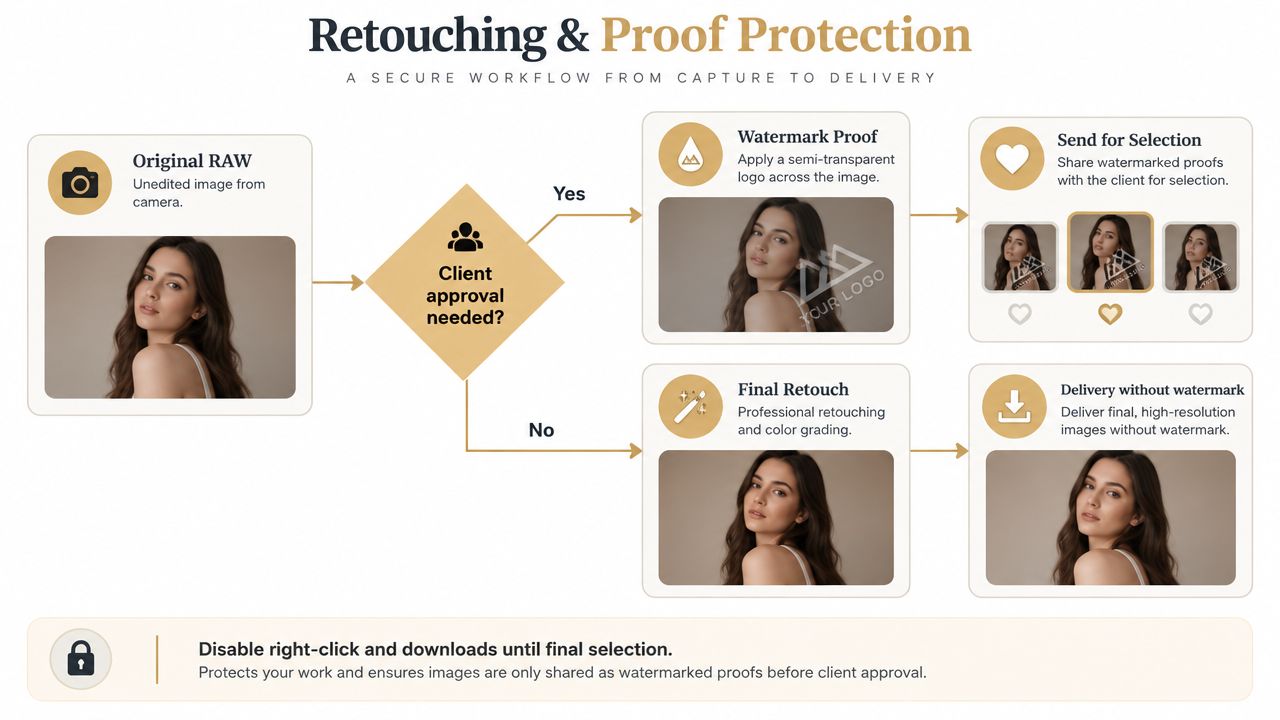
Retouching should begin only after the client's choices are known. The photographer first culls the session, then prepares a proof set, then retouches selected images. An image that the client didn't select shouldn't enter the retouching queue unless the contract or a later written request changes that decision.
Every proof should carry a diagonal, semi-transparent studio logo across the torso, not across the face. The mark needs to identify the preview as unfinished while preserving the client's ability to judge pose, composition, expression, and overall image quality. A watermark placed only in a corner is easier to crop from a screenshot, which makes it a weak control for intimate work.
Keep downloads disabled while proofs are visible. The combination of a visible watermark and blocked downloads protects the unretouched file more effectively than either setting alone. The gallery introduction should state the difference plainly:
Proofs: Watermarked and lightly color-corrected for selection.
Finals: Retouched, unwatermarked, and exported in the agreed format and size.
The studio should apply one consistent retouching standard across the selected set. That means the photographer defines the treatment before work begins rather than negotiating skin, body, or fabric adjustments image by image. The agreement should identify whether the final delivery includes color correction, skin refinement, object removal, or more extensive alterations.
Tag selected images in the digital asset manager, export the finals in the agreed format and size, and replace the proof files inside the same private gallery when the platform supports that workflow. Keeping the original access path reduces confusion and lets the client recognize the handoff. One short email should explain that the proof files have been replaced, downloads are now available, and the expiry date remains unchanged unless the studio has expressly reset it.
The guidance on watermarking photos to protect work is useful for documenting the protection logic. Watermarks aren't a substitute for consent or access control, but they are a necessary visual signal during review.
Closing the Gallery After Delivery
Gallery closure should follow a written sequence. Memory is unreliable after a busy delivery week, and a forgotten link can remain accessible long after the client believes the project is finished.
1. Match the approved list
Confirm that the client's submitted selection list is complete and matches the tags in the digital asset manager. Resolve discrepancies before enabling final downloads. If a file appears in the gallery but not in the approved list, it stays out of the final set until the client provides a clear decision.
2. Notify before enabling downloads
Send the client a discreet message stating that the retouched finals have replaced the proofs. Repeat the download deadline and explain the agreed format or size. Downloads shouldn't be enabled until that email has been sent, because the client needs context before receiving access to the unwatermarked files.
3. Close and verify access
After the download window ends, disable the gallery or revoke access. Review any gallery analytics the studio needs for its records, then open the URL in a private browser session to confirm that it returns an expired notice rather than a working gallery or a confusing login screen. Secure file-sharing guidance recommends communicating the end date in advance and checking whether selections, downloads, or corrections remain before closure, as outlined in this secure file-sharing workflow.
4. Archive under the original terms
Archive the originals, signed consent, final selection record, and a screenshot of the expired link under the retention terms agreed before the shoot. Don't create a new retention policy years later that expands permission without notice. The archive should distinguish master files from working copies and should preserve the record of what the client approved.
5. Remove working copies
Delete local working copies from devices that aren't the studio's master archive. This includes temporary exports, download folders, desktop previews, and messaging attachments. Keep the master archive governed by the consent record, not scattered across personal devices.
Send one close-out email confirming the final gallery status, the closure date, and the location of the studio's retained records. Closure is a procedural privacy control. It doesn't diminish the client relationship. It shows that the photographer treats access as temporary and intentional.
Final Privacy Checklist and Follow-Up
Before sending a boudoir photography client gallery, the photographer should run one checklist rather than rely on memory. The checklist needs to cover both the client's consent and the gallery's technical settings.
- Consent record: Confirm that the signed agreement covers image use, partner visibility, social permissions, and the person authorized to make selections.
- Credential separation: Send the private gallery URL by discreet email and the password or PIN through a separate channel. Independent private-gallery guidance recommends unique passwords, never reusing a password across galleries, sending the password separately, hiding the gallery from public pages, and using unlisted or search-engine visibility controls, as explained in this private online photo gallery guidance.
- Expiry control: Set the expiry date before delivery and state the end date in the message. Password and time-limited access are also established mechanics in mainstream file-sharing systems, including Dropbox plans that support shared-link passwords and expiry dates, as summarized in this password-protected photo gallery comparison.
- Selection lock: Disable downloads during proofing, define the meaning of hearts or stars, assign one decision-maker, and record the submission deadline.
- Preview protection: Apply watermarks to every proof and check that the mark remains visible on a mobile screen without obstructing the client's face.
- Stage separation: If the studio uses two-stage delivery, confirm that finals aren't exposed in the proof gallery and that the retouching queue contains only approved files.
- Archive record: Record the archive destination, original consent terms, retention period, final selection list, and planned closure date.
The follow-up cadence should stay short and repeatable. Send a thank-you message within 48 hours, and restate the gallery expiry date so the client knows the next action. Handle any re-share or extension request through re-authentication, and don't redistribute raw files through email or informal messaging. Run a 30-day re-share check against the studio's policy, then ask for a referral only after the client has had time to share the final images privately with a partner.
A platform such as SendPhoto can fit this workflow when a photographer needs password-protected private galleries, watermarks, download controls, expiring links, mobile-ready viewing, favorites, and selections without requiring the client to create an account. Its published platform description also identifies bulk photo and video upload, gallery organization, automatic cleanup, and branded presentation features, so the photographer should verify the current plan and settings before promising any specific capability.
A photographer can use SendPhoto to organize a private client gallery, collect favorites or selections, control downloads, apply watermarks, and set expiring access for a more deliberate boudoir delivery process. Visit SendPhoto to review the current gallery controls and decide whether its workflow matches the studio's consent, proofing, and closure policy.